Automatic standby generators sized to what your house actually draws, with a transfer switch that does the work while you are asleep or away. Out here the power can be off for days, and your well pump should not care.
Standby generator installation in Uxbridge is not a city product sold to rural people. On this side of Durham a winter storm or a summer squall can put a road out for two or three days, and a house on a private well and a septic pump is not simply inconvenienced by that, it stops working. No water, no toilet, and in January no heat.
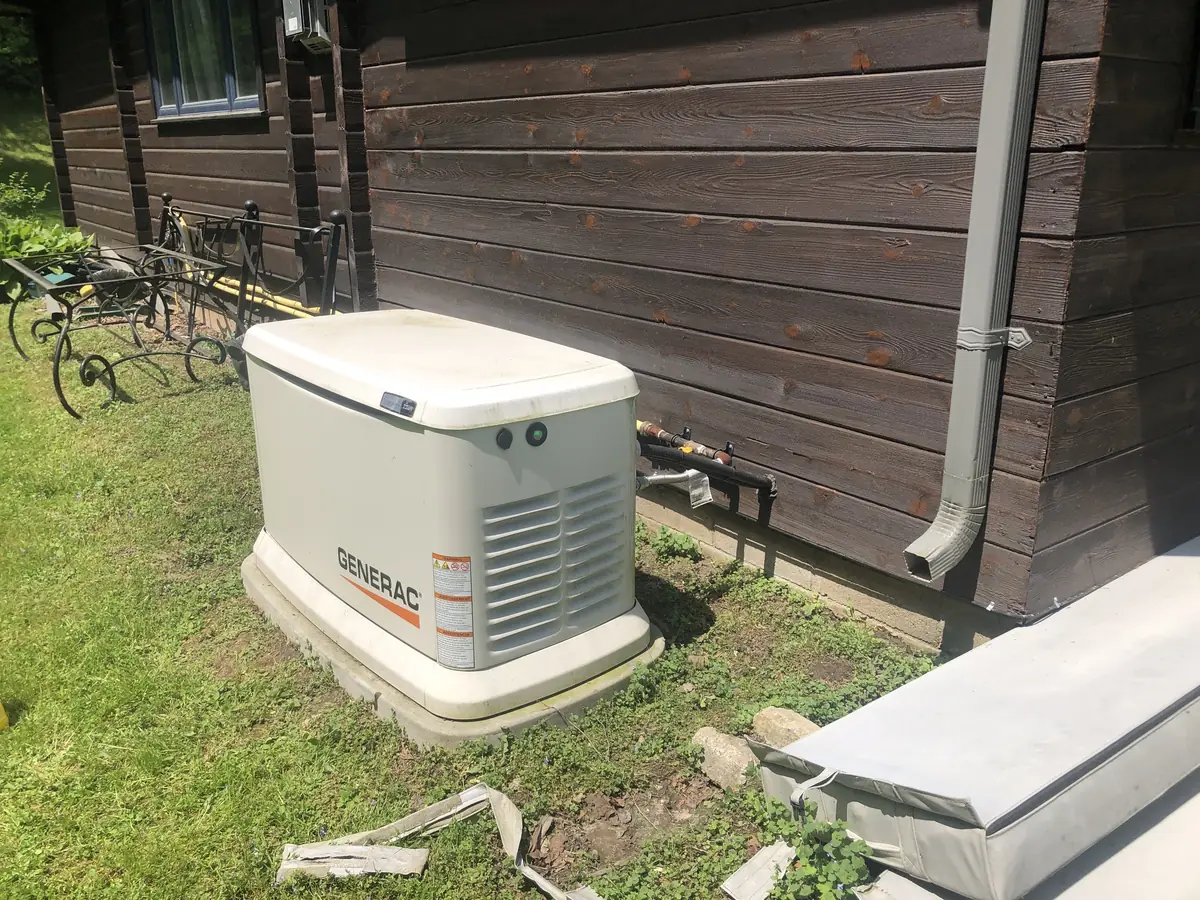
An automatic standby unit sits outside like an air conditioner, watches the incoming supply, and when it disappears it starts, waits a few seconds, and the transfer switch moves the house across. You do not have to be home. You do not have to drag anything out of the garage or run extension cords through a window. When Hydro One or Elexicon restores the line, it hands the house back and shuts down.
The mistake that makes people unhappy with a generator is buying it by the number on the box. What matters is what has to run at once and what it takes to start. A submersible well pump draws several times its running current for the first second. So does a furnace blower, a sump pump and a fridge compressor. Three of those starting together is what actually decides the size.
So I do a load calculation on your house, not on a house. Then you choose between two honest approaches:
Natural gas is the easy version: the unit runs indefinitely and nobody has to think about it. Plenty of properties around Uxbridge, Sunderland and Cannington are not on the gas main, which means propane, and propane means a tank sized for days of running rather than for a barbecue. A 100 pound cylinder is not a standby fuel supply. That conversation happens before you buy anything, not after, because it changes both the cost and where the unit can sit.
Siting has rules too: clearance from windows, doors and vents so exhaust cannot get back in, clearance from the gas meter, a level pad, and somewhere the snow will not bury it by February.
Installed, a home standby in Ontario generally runs from around $11,000 to $17,000 for a typical air-cooled unit, and the spread is real rather than padding. The transfer switch alone is usually $1,500 to $3,000 of that. What moves it: the size of the unit, how far the electrical and the gas have to run from the panel and the meter, whether the pad needs building up, and whether you are on natural gas or propane. Permits add a few hundred.
The cheapest version of this is a manual transfer switch and a portable unit you start yourself. It is a legitimate answer for some people and I will install one properly if that is what you want. What I will not do is let anyone back-feed a house through a dryer outlet. That energises the line outside and it is how linemen get killed.
A standby unit exercises itself weekly and it still needs oil, filters and a battery on a schedule. The battery is the part that quietly dies and it is the part that stops the unit starting on the one night it matters. Worth putting in the calendar, and worth an annual look at the transfer switch.
Generators are a rural product here, so the work clusters well outside the village.
Once you are off the municipal water, a power cut means no well pump and, on a pumped septic, no drainage either. That is what turns two days without power from annoying into a real problem, and it is why most of my generator calls come from the concession roads rather than the village.
Long rural feeders, more trees between you and the substation, and restoration that fairly reasonably works from the biggest outage down. Most of these properties are on propane, so tank sizing is part of the quote rather than an afterthought.
Older farmhouses with outbuildings, where the load list often includes a barn, a shop or a stock waterer that cannot simply be shed. Those get worked into the calculation properly instead of being discovered during the first outage.
Anywhere else in Durham Region, York Region or the Kawartha Lakes, ring me and I’ll tell you straight whether you are in range. Most of my week sits within about forty minutes of Uxbridge.
Most of my jobs end up being two things at once. These are the ones that usually come up alongside this work.
Tell me roughly what your house runs on and how long the last outage lasted, and I can give you a realistic size and a realistic number.
Licensed & insured · ECRA/ESA #7018329 · Durham Region, York Region & Kawartha Lakes