Fuse boxes out, modern breaker panels in, 100A services taken up to 200A, and sub-panels for additions and shops. I pull the ESA permit, meet the inspector, and label every circuit before I pack up.
An electrical panel upgrade in Uxbridge is the job I get called for more than any other, and it is almost never because someone woke up wanting one. It is because an insurer asked, or a home inspector flagged it, or the fuse box finally stopped coping with a house that has picked up an air conditioner, a hot tub and a car charger since it was built.
Your panel is the one part of the electrical system everything else hangs off. When it is undersized, corroded, or full of a brand nobody will insure any more, it is not just inconvenient, it is the thing standing between a fault and your house. I change panels properly: new service mast and meter base where it needs one, a correctly sized board, every circuit identified as it is landed, and the ESA paperwork in your hand at the end.
200AThe service size most Uxbridge homes end up on
1 dayTypical changeover, power back on the same day
ESAPermit pulled and inspection met under my licence
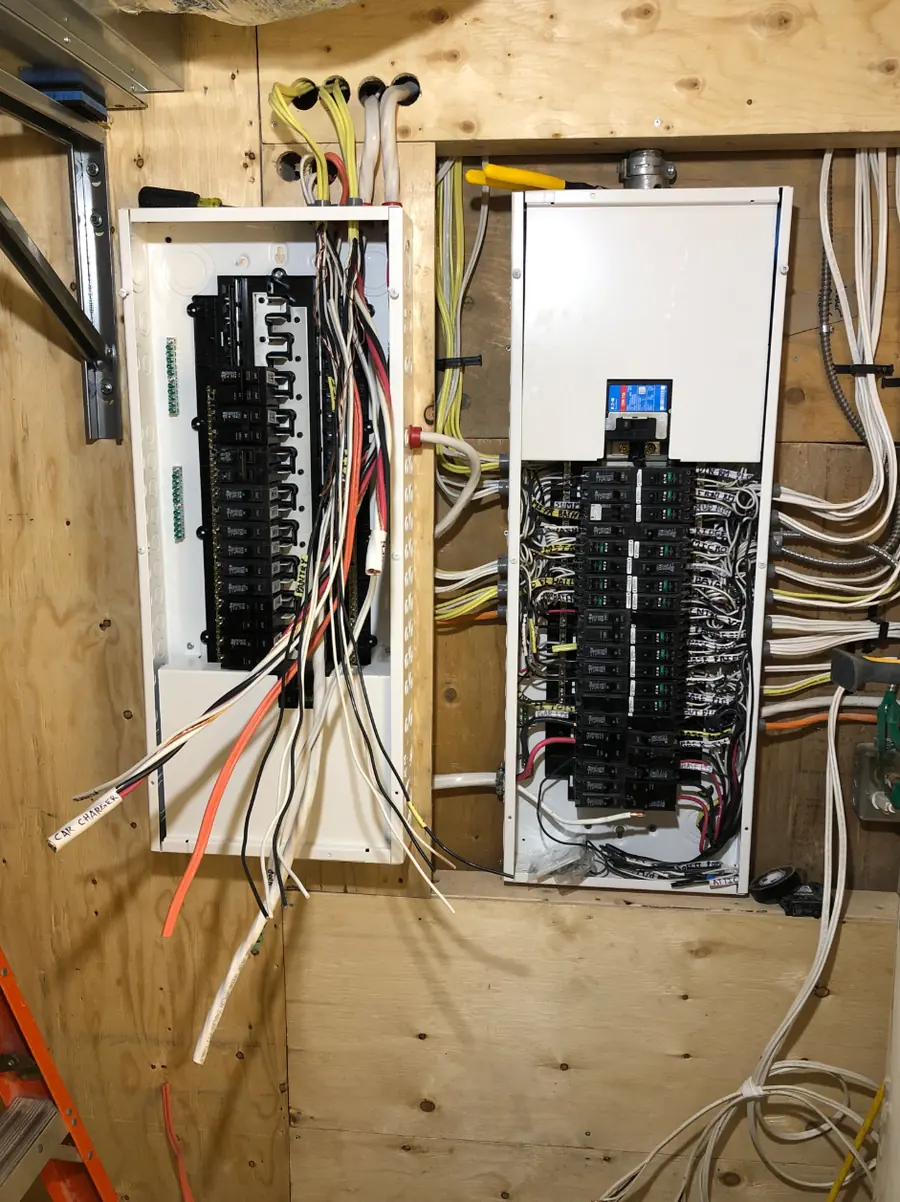
Mid-change: the old board on the left, the new one on the right, circuits moving across one at a time.
Signs your panel is due
You do not need to guess at this. A panel tells you it is finished in fairly specific ways, and if any of these are true it is worth a look:
It is a fuse box. Not automatically dangerous, but most insurers now load the premium or decline outright, and you cannot add a modern circuit to one sensibly.
Federal Pioneer Stab-Lok or Zinsco. Both have a long history of breakers that do not trip when they should. If that name is on your door, get it looked at.
Breakers that trip repeatedly. One circuit failing over and over means something is drawing more than it should, and resetting it is treating the alarm rather than the fire.
No space left. Double-tapped breakers and tandem fills are how a panel ends up overloaded without anyone deciding to overload it.
Rust, scorching, or a warm cover. Water in a meter base or heat at the lugs is a same-week job, not a someday job.
You are adding load. An EV charger, a hot tub, a heat pump, a workshop or a basement suite all need headroom you may not have.
What a panel change actually involves
People picture a quick swap. What it really is:
A load calculation first. Square footage, heating type, range, dryer, air conditioning, EV, hot tub. That number decides whether you need 100A, 200A, or more, and it is what the inspector checks against.
The ESA notification. Filed under my ECRA/ESA licence before work starts. This is not optional and it is not an extra I bolt on at the end.
Coordinating the disconnect. Uxbridge is split between two distributors, so whether the disconnect is arranged with Hydro One or with Elexicon Energy depends which side of the township you are on. I sort that out, not you.
Mast, meter base and grounding. On most upgrades the service conductors, mast and meter base go too, and the grounding and bonding get brought up to current code, which is often the part that was never right in the first place.
Circuits moved one at a time. Each one traced, tested and labelled as it lands. That is what the video on my home page is showing.
The inspection. I meet the ESA inspector myself and you get the Certificate of Acceptance. Keep it, your insurer and the next buyer's lawyer will both ask.
Overhead or underground makes a real difference
Where the power reaches your house from changes the job more than the panel itself does. An overhead drop from a pole is the straightforward version. An underground service means the run from the transformer or pedestal is buried, and if that cable is undersized for the new service it has to be replaced, which means the trench. Out on the rural roads around Uxbridge, plenty of homes are fed a long way from the road, and that distance is what moves the number.
What a panel upgrade costs
Across Ontario a straightforward 100A to 200A change generally lands somewhere between about $2,500 and $4,500 including the ESA permit, and the GTA end of the range runs higher. Underground services and long rural runs sit above that again. I am not going to quote your house off a web page, but I will tell you what actually moves the number:
Whether the mast, meter base and service conductors go with the panel
Overhead versus underground, and how far the run is
How much of the existing grounding and bonding is reusable
Whether the new panel lands in the same spot or has to move
How many circuits need repairing before they are fit to land in a new board
You get that range before I start, not after. If something opens up behind the old panel that moves it, you hear about it while there is still a decision to make.
Where I do this work
Panel changes are the job that takes me furthest from home, because the older housing stock is not evenly spread across the township.
Uxbridge
The village core and the older roads out toward Quaker Hill have plenty of 60A and 100A services that were sized for a house with far less in it. Most of the fuse boxes I still take out are within ten minutes of the four corners.
Port Perry
A lot of the lakeside and older Scugog housing was built or extended in stages, so the panel is often newer than the wiring feeding it. That changes the job, and it is worth knowing before the quote, not during.
Goodwood and Sandford
Rural services, long underground runs from the road, and outbuildings that were fed off the house years ago. Sub-panels for a barn or a shop are the usual second half of these jobs.
Anywhere else in Durham Region, York Region or the Kawartha Lakes, ring me and I’ll tell you straight whether you are in range. Most of my week sits within about forty minutes of Uxbridge.
Questions people ask me
Do I need an ESA permit for a panel upgrade in Ontario?
Yes. A panel or service change has to be reported to the Electrical Safety Authority and inspected, and only a licensed electrical contractor can file it. I file it under ECRA/ESA #7018329 before the work starts and I meet the inspector myself. Unpermitted panel work causes real problems later: it can complicate an insurance claim and it turns up when a buyer's lawyer checks the ESA record.
How long will my power be off?
Most of the day for a standard changeover, and back on the same evening. I will tell you the window before the day so you can plan around the fridge, the freezer and anyone working from home. If the mast and meter base are going too, it can stretch, and you will know that in advance.
Is 100 amps enough, or do I need 200?
It depends on a load calculation, not on a rule of thumb. A modest house with gas heat and no EV can still be fine on 100A. The moment you add electric heat, a car charger, a hot tub or a shop, 200A is usually the sensible answer, and doing it once is cheaper than doing it twice.
Can you just add a breaker instead?
Sometimes, and if that is genuinely the right answer I will tell you so. What I will not do is squeeze another tandem into a board that is already full or already a brand nobody will insure. That is how you end up paying for a panel change anyway, later, with a repair bill in front of it.
Do you replace Federal Pioneer Stab-Lok panels?
Regularly. It is one of the most common reasons I get called. Replacement breakers for them are hard to trust, and a lot of insurers have their own view on the brand, so a full change is usually the cleaner answer than chasing parts.
Will I get paperwork at the end?
Yes. The ESA Certificate of Acceptance, in your name, for your file. Keep it with the house. It is the document that answers the question every insurer and every buyer eventually asks.
While I’m there
Most of my jobs end up being two things at once. These are the ones that usually come up alongside this work.