Noble Elec Noble ElecUxbridge, Ontario
LED Lighting · Uxbridge, Ontario

LED Lighting Installation in Uxbridge, Ontario

Pot lights, retrofits, under-cabinet runs, pendants and outdoor lighting. Better light, a smaller hydro bill, and dimmers matched to the fixtures so they actually hold low without buzzing.

LED lighting installation in Uxbridge is the job people enjoy most, because unlike a panel change you can see what you paid for. A kitchen that was lit by one fixture in the middle of the ceiling and a strip under a cupboard becomes a room you can actually work in. A dining room gets a fitting hung where the table is rather than where the joist happened to be.

It is also the job most often done badly, and the reason is almost always the same: the fixtures and the dimmer were bought separately by people who never spoke to each other. That is where the buzzing, the flicker and the lights that will not go below about a third come from.
75%Roughly the load an LED retrofit takes off a lighting circuit
2700KWarm white, what most people actually want indoors
IC/ATRated housings where pot lights meet insulation
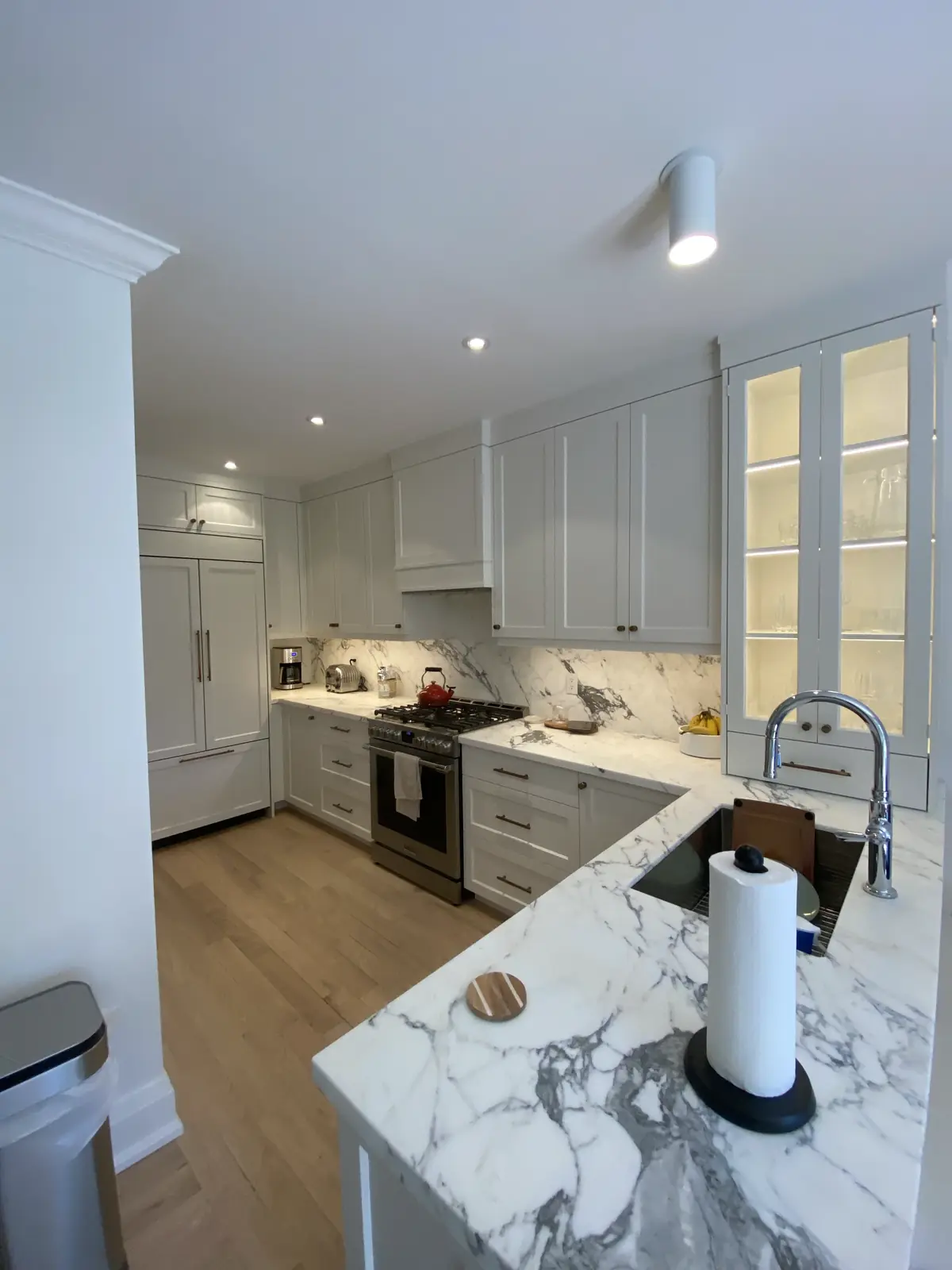
Kitchen after an LED upgrade in Uxbridge, recessed pot lights, lit glass upper cabinets and an adjustable track head
Recessed LED, lit glass uppers and one adjustable head over the counter. All dimmable, all on matched drivers.

What I install

  • Pot lights, new. Laid out on the room rather than on a grid, so the light lands on counters, seating and walls instead of on the middle of the floor. Cut, wired and boxed properly, with IC and airtight rated housings anywhere they meet insulation.
  • Retrofits into existing cans. Much cheaper than starting again where the housings are sound, and a good first step if you are not renovating.
  • Under-cabinet and in-cabinet. Continuous runs on a driver that lives somewhere serviceable, not glued behind a cabinet back where nobody can reach it in four years.
  • Pendants, chandeliers and linear fittings. Boxed and braced for the actual weight, centred on the furniture, and levelled. Heavy fittings need a fan-rated or fixture-rated box, and a lot of the ones I take down were not on one.
  • Outdoor and landscape. Soffit, path, and driveway lighting, wet-rated fittings on GFCI protection, which matters a great deal more here than it does downtown.
  • Shops, garages and barns. Linear LED that starts instantly in the cold, which the old fluorescent tubes in most Uxbridge garages emphatically do not.

Getting the dimming right

This is the part worth reading. An LED draws a fraction of the current an incandescent bulb did, and an old leading-edge dimmer designed for a 300 watt load cannot see a 40 watt one properly. That is the buzz, the flicker, and the drop-out at the bottom of the travel. The fix is not a better bulb, it is a matched pair:

  • The fixture has to be genuinely dimmable, and its driver has to say so
  • The dimmer has to be LED-rated, and for most modern drivers that means trailing-edge rather than leading-edge
  • The minimum load of the dimmer has to be below the total load of the circuit, which is what catches people when they dim two lights instead of ten
  • Mixing brands of driver on one dimmer is how you get one fitting that lags behind the rest

I spec the two together. It is not a premium option, it is the difference between lighting you like and lighting you stop using.

Colour temperature, and why the first bulb you bought was wrong

Most people who say they do not like LED bought 5000K by accident. That is daylight, and it is right for a garage and wrong for a living room. Indoors, 2700K reads as warm and familiar, 3000K is a bit crisper and works well in kitchens and bathrooms, and anything above 4000K starts to feel clinical. Consistency matters as much as the number: three fittings at slightly different temperatures in one room is more noticeable than any of them being individually wrong. Worth a CRI of 90 or better anywhere you cook, get dressed or look at a mirror.

What LED work costs

Pot lights are priced per light, and the number moves with the ceiling, not the fixture. An open basement ceiling is straightforward. A finished ceiling with a room above it means fishing, and an insulated attic above a vaulted ceiling is a different job again. As a rough guide, six pot lights in a kitchen commonly lands in the $1,200 to $1,500 range once dimmers and switching are in, and a good LED-rated dimmer is $40 to $80 of that.

The one real saving worth knowing: if a ceiling is already open for a renovation, doing the lighting then costs substantially less than coming back afterwards. If you are planning work, get the lighting laid out before the drywall goes on.

Where I do this work

Lighting work follows renovations, so it clusters where people are opening ceilings.

Uxbridge

A lot of my lighting work here is kitchens and basements in houses from the eighties and nineties, where the ceiling gets opened anyway and the lighting layout can finally stop being one fixture in the middle of the room.

Stouffville and Brooklin

Newer subdivision housing where the builder fitted the minimum, so the job is usually adding pot lights and proper under-cabinet runs to a house that is otherwise fine. Straightforward ceilings, quick work, and the ROI on the hydro bill is quickest in the rooms that are lit all evening.

Markham and Newmarket

Further out than most of my week, so I take lighting work there when it is a whole-house package rather than two fittings. Worth asking, and I will tell you honestly if the drive makes it not worth your money.

Anywhere else in Durham Region, York Region or the Kawartha Lakes, ring me and I’ll tell you straight whether you are in range. Most of my week sits within about forty minutes of Uxbridge.

Questions people ask me

Why do my LED lights flicker when I dim them?
Almost always a mismatch between the dimmer and the driver. Old leading-edge dimmers were built for a much larger load than an LED presents, so they cannot hold a steady output at the bottom of the range. Swapping to a trailing-edge, LED-rated dimmer rated for the actual wattage on that circuit fixes the great majority of cases.
Do pot lights need to be a special type near insulation?
Yes. Anywhere a recessed fixture can be covered by or come into contact with insulation it has to be IC rated, and airtight rated is worth having as well so you are not venting heated air into the attic through six holes in the ceiling.
How many pot lights does a room need?
Fewer than most people are quoted. Light the surfaces you use rather than filling the ceiling with a grid. A kitchen usually wants light on the counters and the island rather than evenly over the floor. I will lay it out on site and walk you through where each one lands and why.
Can you put pot lights in a finished ceiling?
Yes, and it is normal work. It means fishing the cable and cutting neatly, and where there is a room above rather than an attic it takes longer. I will tell you before I start where access is going to be awkward and whether any patching will be needed.
Will LED actually save me money?
On the hydro bill, yes, and most of the saving comes from the rooms that are lit for hours every evening rather than from a closet light. The bigger practical win is usually that you stop replacing bulbs in a stairwell or a vaulted ceiling you need a ladder to reach.
What colour temperature should I pick?
2700K for living rooms and bedrooms, 3000K for kitchens and bathrooms, 4000K or higher only for a garage, shop or laundry. Keep it consistent within a room. If you are unsure, I will bring both and you can look at them in your own space before deciding.

While I’m there

Most of my jobs end up being two things at once. These are the ones that usually come up alongside this work.

Contact me

Lighting you actually like?

Tell me the room and what is wrong with it now. Most lighting problems are a layout problem or a dimmer problem, and both are fixable.

Licensed & insured · ECRA/ESA #7018329 · Durham Region, York Region & Kawartha Lakes

(647) 228-0568 Text me